Posted by Alexander Goldin
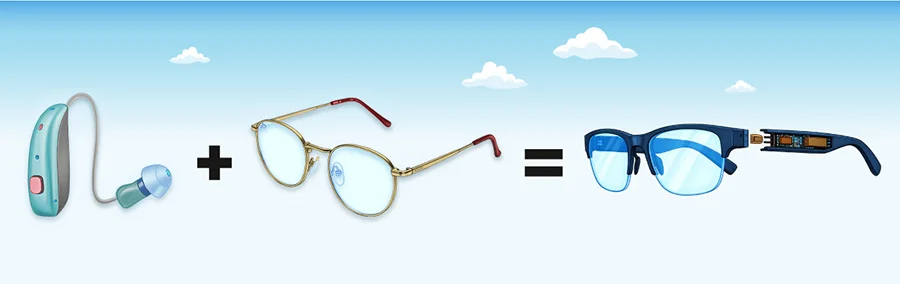
| Introduction The number of people with hearing loss is about 1.5 billion today and is projected to reach nearly 1.9 billion by 2030. Approximately two-thirds of these individuals have mild to mild-moderate hearing loss, and most do not use any hearing-enhancement devices. As a result, they struggle mainly in specific, challenging situations – most often in noisy or reverberant environments – but either do not want to use, or cannot afford, traditional hearing rehabilitation devices such as hearing aids. Could smart audio glasses with hearing enhancement be a solution? Glasses that look almost normal, yet improve hearing without signaling hearing impairment?
Hearing Glasses as the Mainstream Solution While hearing glasses have existed for decades, they have never become mainstream for improving hearing. Earlier devices were often bulky and underpowered, offering minimal amplification and limited personalization that addressed only a narrow range of hearing needs. They also lacked sufficient battery life for all-day use and did not provide modern features such as audio streaming or voice calls. Technology has since advanced, with smaller, lighter acoustic components, more powerful silicon, advanced AI algorithms, and full Bluetooth voice and audio connectivity. The question is – will this finally change the outcome? Will hearing glasses gain a major, mainstream role in hearing rehabilitation, or will they remain a niche where small players who cannot compete with the BIG 5 on the main turf struggle? To deduce an answer, it helps to look at parallels from history and other markets.
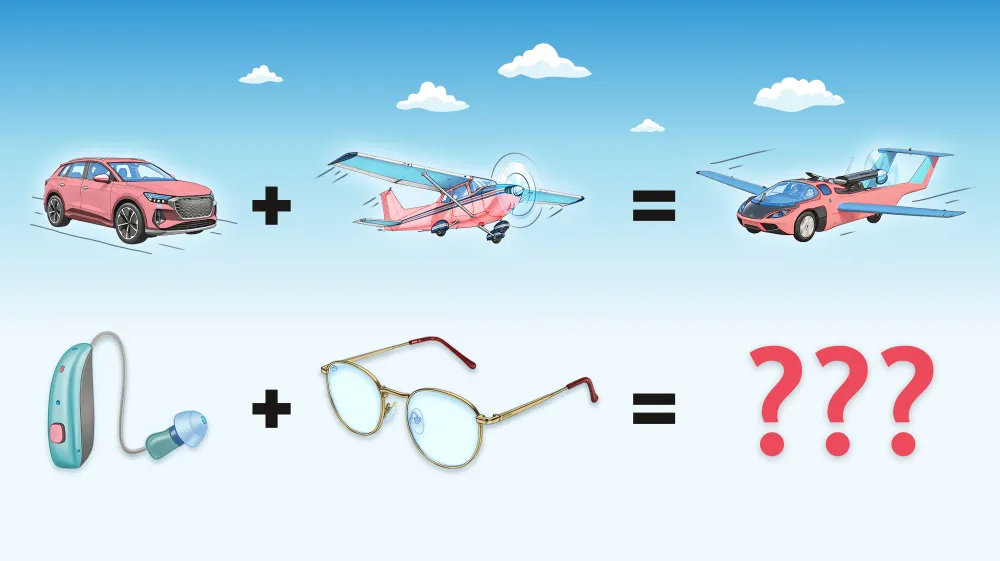
The Flying Car Analogy Adding hearing enhancement to optical glasses is a bit like creating a flying car. Both ideas seem very natural. For decades, drivers dreamed of cars that could fly over traffic jams. We have seen flying-and-driving prototypes and even commercial flying cars. But have they become mainstream? Has traffic congestion disappeared? When two fundamentally different functions are combined, there are unavoidable trade-offs. A flying car is fascinating, innovative, and useful for a niche – but it does not replace a real car, nor does it replace a real airplane. Smart hearing glasses face the same reality.
Physical and Acoustic Tradeoffs Beyond performance, there are fundamental physical and acoustic trade-offs. Integrating speakers, microphones, batteries, processors, and antennas inevitably adds weight and volume. That mass must be concealed somewhere, which drives frame designs toward thicker, heavier, and more constrained form factors. In contrast, ear-worn devices such as earbuds and hearing aids are engineered from the ground up to be ultra-lightweight, acoustically optimized, ergonomically balanced, and suitable for all-day wear. Open speakers in glasses also cause significant sound leakage, which increases acoustic feedback (whistling) and limits maximum usable amplification. Additionally, the acoustic output power of such tiny open speakers is often insufficient in noisy environments. Their sound quality is typically inferior even to the cheapest true wireless earbuds.
As a result, combining optical glasses with hearing amplification creates a hybrid similar to a flying car: neither excellent glasses, nor an effective hearing aid, nor a reliable voice and audio streaming device.
The Good News Glasses provide an excellent platform for placing multiple microphones around the head, enabling superior front-facing directionality (beamforming). When combined with advanced AI noise-reduction technologies, this can offer a powerful form of situational hearing assistance – sometimes even allowing users to understand speech better than people with normal hearing in specific scenarios. This capability should not be overlooked. However, it must be advertised honestly and intelligently: no overpromising, just clear benefits for users willing to accept certain compromises in exchange for improved conversational ability in noisy environments.
Conclusion Convergence is exciting. Specialization is essential. Flying cars and hearing-enhancement glasses may each attract many users. Smart glasses with hearing features can complement the ecosystem, but they cannot replace purpose-built hearing solutions at scale. |